Moss Stitch Border Tutorial (& the Naming Drama that Goes With It)
Your blanket is done, or it’s close enough to done that you’ve been calling it done for four days while it sits on the arm of your couch collecting pet hair and side-eyeing you every time you walk past it. You bound off, you wove in your ends (or you did that thing where you pulled the yarn through a few stitches, declared victory, and decided that was someone else’s problem), and now it’s just sitting there with raw floppy edges waiting for you to finish what you started.
It needs a border. This one, specifically.
The moss stitch border is one of those finishing moves that makes a blanket look like you had a plan from the beginning instead of crocheting for six weeks and panicking at the finish line. It adds texture without bulk, it doesn’t fight with whatever stitch you used for the body of the project, and the repeat is so straightforward you’ll have it memorized before you hit your first corner. Two stitches, one skip, repeat until it looks done.
Here’s what I need you to know before we get into it though: if you’ve Googled “moss stitch” before landing here and found something that looked nothing like what I’m about to teach you, you’re not confused and you didn’t end up on the wrong page. Crochet has been having an active naming crisis over this stitch for years. The stitch I’m teaching you is the original moss stitch, which got its name quietly handed off to a completely different construction somewhere on the internet and nobody apologized for it.
We’re going to talk about that, because it’s honestly kind of funny.

Heads up: My posts may contain affiliate links! If you buy something through one of those links, you won’t pay a penny more, but I’ll get a small commission, which helps keep the lights on! Thanks!
PS. If your panic spiral has started to convince you that your project looks like crap and you’re the problem way before we even get to the border, grab my free beginner guide. Thirty-five pages of “calm down, you’re not the problem” and it’s completely free. Check it out here.
Materials Needed:
- Yarn (Duh) – Whatever yarn you used for your project. Same weight, same color, or a contrasting color if you’re feeling bold about it.
- Hook (Again, Duh) – Whatever size you used for the project itself. No need to change anything here.
- Your Finished Project – Blanket, scarf, dishcloth, whatever sad-edged thing brought you here today.
- Scissors and a yarn needle – For weaving in your ends when you’re done so you can actually call this thing finished.
- Babysitter, Netflix, snacks, Diet Coke… – The real essentials. You know what you need.
What Is the Moss Stitch Border, Actually
Here’s the thing about crochet: it will name something, decide it doesn’t like that name anymore, hand it to a completely different stitch, and never once apologize.
The sc/dc combo you’re about to learn? That’s the original moss stitch. Been called that for years. Then the linen stitch (sc, ch1, skip, repeat) showed up, crochet Twitter collectively decided to call THAT the moss stitch instead, and just… evicted the original. No warning. No forwarding address. The traditional moss stitch is out here doing the same thing it’s always done and has to share a name with a completely different construction now because the internet said so.
So if you’ve Googled “moss stitch” before landing here and thought you were getting one thing but you’re seeing another: you’re not losing your mind. Crochet just chose violence.
Now, what you’re actually doing here.
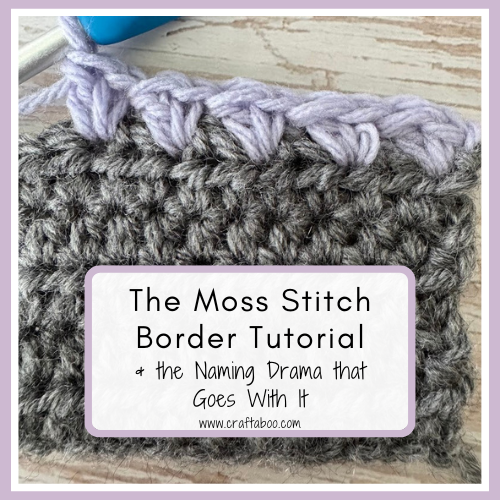
The construction is genuinely simple. You work a single crochet and a double crochet into the same stitch, skip the next stitch, and repeat that all the way around your project. That’s the whole thing. The sc and dc worked together into one spot creates a little cluster that stacks up into a dense, textured border with actual visual weight to it. It sits flat, it doesn’t curl, and it plays nice with basically any stitch pattern you already used for the body of your blanket.
But before you get into the moss stitch border, I’d highly encourage you to work an entire round of single crochet as a border first. That sc foundation round is what gives you clean, consistent stitches to work into, and without it your moss stitch is going to fight you the whole way around. The full walkthrough for that part is right here. Go do that and come back. I ‘ll wait.
Moss Stitch Border Walkthrough
To Begin:
Join your border yarn (or new color) anywhere on your project and chain 1. (Corners work great!) Then make 1sc and 1 dc all in the same stitch.

Skip the next stitch then do 1sc and 1dc in the next stitch.

Continue doing this stitch all along one side of your project until you get to the first corner.

Corners: Don’t Skip This Part. Seriously
Corners are where this border can get out of hand quick if you’re not paying attention. So consider yourself forewarned.
When you hit a corner stitch, you’re not just going to keep repeating the same sc/dc cluster and moving on. If you do that, your corners are going to pull tight, cup inward, and make the whole border look like it’s trying to fold itself in half. That’s not the vibe because I have stated that this stitch plays nice, and I am a woman of my word. The fix is simple but it has to happen every single time you reach a corner. Not hard, just worth paying some extra attention to.
Working Corner Stitches
Work your sc/dc cluster into the corner stitch like normal, then chain 2, then work another sc/dc cluster into that same corner stitch before you continue on. That chain 2 in the middle is what gives the corner enough room to actually turn flat instead of pinching. Four corners, same thing every time, and your border lays down like it’s supposed to.


If you skip it on even one corner you will absolutely be able to tell, and so will everyone else who looks at your blanket.
Once you’ve tackled the corner situation and feel confident, continue working your cluster stitches along your remaining sides, doing your repeats in the corners until you make it all the way back around. Join with a slip stitch to the first stitch you made, and tie off and weave in ends.

And now you have completed the moss stitch as a border around your project! To do a second or third round you’re going to repeat this process exactly, working your cluster stitches int he spaces between stitches from the previous row.

If you are a visual learner like me, and need a walkthrough on how to make the stitch, (including how to make a second round) I’ve got you covered. Check out the video below. This walks you through how to make this stitch step by step. So watch, pause and rewind as much as you need to until it clicks.
Moss Stitch Border FAQs
- My stitch count is even. Is that a problem? If you end up with an even number of stitches on a side, just work a single crochet into the last stitch of that side without doing the skip, then go straight into your corner. You will not be able to see it once it’s done. Do not let an even stitch count be the reason you abandon a perfectly good border.
- How many rounds do I do? However many you want. One round gives you a thin, subtle edge. Three or four rounds gives you a border with actual presence. There’s no wrong answer here, just keep going until it looks proportional to the size of your project and then stop.
- Can I use a different color? Absolutely, and honestly it looks really sharp when you do. Just join your new color at the beginning of the sc foundation round and work the whole border in that color. Or pick your chaos level and switch colors every row. No judgement.
- My border is rippling and ruffly. What happened? You’re working too many stitches and not skipping consistently. The skip is not optional, it’s what keeps the whole thing flat. Go back and check that you’re doing the sc/dc cluster and then actually skipping the next stitch before you repeat. (Yes, I know frogging is soul destroying, but sis, it’s the only way…I’m truly sorry)
- Can I use this border on something other than a blanket? Yep. Dishcloths, scarves, placemats, pretty much anything rectangular that needs a finished edge. The only thing to keep in mind is that this border has some visual weight to it, so on something really small and delicate it might overpower the project. Use your judgment.
Final Thoughts:
Your blanket has a border now! That thing that was sitting on your couch collecting pet hair and side-eyeing you for four days is actually finished, and it looks like you planned the whole thing from the start. Go you!
If you’re still building out your stitch vocabulary, the beginner stitch library has everything else broken down the same way – no skipped steps, no assumed knowledge. And if you need something to put this border on, the blanket patterns section has options at every skill level.
If this border clicked for you and you want to see what else is in the finishing toolkit, the techniques and tutorials page is where all of that lives. The crab stitch border and the single crochet border are both over there and both worth having in your back pocket.
Still in the “am I doing this right or have I personally invented a new problem” phase of learning? The Don’t Panic guide is free and it exists for exactly this.
Drop a comment below if you used this border on something. I’m nosey and I want to see it.