Crochet Puff Stitch Tutorial (Yes, That Many Loops Is Correct)
It started like every other crochet pattern you’ve ever done. You were minding your own business, following along with something that seemed totally reasonable, and then it just said “puff stitch” like that was a complete sentence. Like you were supposed to already know. Like somewhere between your chains and your double crochets, someone sat you down and explained this whole thing and you just blacked out in the middle and missed everything they said.
So you went looking for help, which, by the way, was the right call. But what you found was either a YouTube video where someone’s hands moved faster than your eyes could track with zero acknowledgment that normal humans might need a second, or a written tutorial that opened with something more akin to ancient Greek than English. Something like “YO, insert hook, [YO, draw up a loop] 3 times” and then just kept going like those brackets explained anything at all.
They didn’t. You know it. I know it, the pattern knows it.
Nobody mentioned what it looks like when you’re in the middle of it. Nobody told you that you’re going to end up with what looks like a small textile disaster sitting on your hook, and that this is not only fine but is actually the whole mechanism working exactly as designed. That part just gets skipped, every time, because the people writing these tutorials already know how it ends and forgot that you don’t.
That’s what this one is for.
Get my free beginner crochet guide It’s completely free! (This is for when your stitches look wrong and you’re convinced you’re the problem – spoiler alert, you’re not)

Heads up: My posts may contain affiliate links! If you buy something through one of those links, you won’t pay a penny more, but I’ll get a small commission, which helps keep the lights on! Thanks!
Materials Needed:
- Yarn – (Duh) Use whatever yarn your pattern is calling for, or if you’re just practicing, my favorite brand is Red Heart Super Saver (because it’s inexpensive, has an insane amount of color choices, and you cry slightly less when the dog decides it’s delicious because you didn’t spend your whole paycheck on one skein)
- Hook (again, duh) – My emotional support crochet hook is a clover amour ergonomic hook. But use whatever hook your pattern is calling for.
- Babysitter, Netflix, Snacks, Diet Coke…
So What Is the Puff Stitch, Actually
Most crochet stitches are just combinations of moves you already know, stacked in a specific order, and nobody tells you this until you’ve already spent three hours convinced you’re the problem. The puff stitch is not some rare advanced technique that lives behind a velvet rope. It’s a cluster stitch, which is a category of stitch where you work multiple incomplete stitches into the same spot before closing them all off at once. If you’ve ever done a triple crochet, you already know the first half of this.
The result is a raised, rounded, squishy little bump that sits on top of your fabric instead of laying flat like everything else you’ve ever made. Not just visual texture, not just a different color or a tighter stitch, but something that genuinely sticks up and can be felt when you run your hand across the surface. It adds actual physical dimension to your work, which is why it shows up in every blanket, pillow, and bag pattern that wants to look like it took more effort than it did.
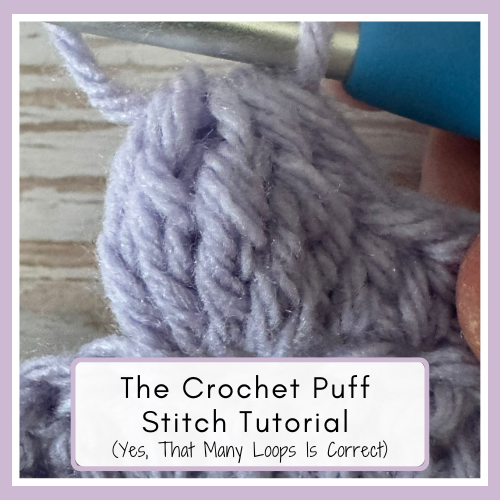
Mid-process it looks unhinged. There will be a moment where you have a stack of loops on your hook that makes zero sense and your brain is going to file a formal complaint. The loops aren’t a sign that something went wrong, they’re the whole structure being assembled before you close the roof on it. The tutorial below walks you through exactly what that’s supposed to look like, so you’re not white-knuckling it through the whole thing wondering if you’ve personally invented a new problem.
The Puff Stitch Walkthrough
Start by yarning over twice. Insert your hook into the stitch, and yarn over again to pull up a loop, yarn over and pull through two loops, then do it again, this is an almost complete triple crochet. Do NOT finish this stitch, leave this as is. There are now two loops left on your hook.


You are now going to repeat this process four more times. Working all in the same stitch each time.


At this point the stitches are starting to get bulky on your hook and can be hard to keep in place. I use my finger to hold them in place as I go through the stitch.


Now you are left with six loops all hanging out together on your hook. To finish the stitch you’re going to yarn over, and pull through all six loops sitting there. This closes the top and completes the puff.

I work into the next stitch after the puff to anchor it to the project and this gives it a good finished look. However, do whatever is directed in the pattern you are working on.

If you are more of a “watch someone do it” kind of learner, I have a YouTube tutorial ready for you. Watch, pause, replay and rewind as many times as you need to get it to stick.
Puff Stitch FAQs
- My puff looks flat. What happened?
- Tension. You pulled those loops up too tight and essentially strangled the puff before it had a chance to exist. When you’re pulling up each loop, go higher than feels right. Generously. The loops need actual room to stack on top of each other. If you’re squishing them down out of habit or anxiety, you’re going to end up with a sad little pancake instead of a puff.
- Wait, is this the same thing as a bobble stitch? Or a popcorn stitch?
- No, and this one trips people up constantly because designers use the names interchangeably like that’s fine when it isn’t. Same general “raised bumpy thing” category, completely different construction under the hood.
- This stitch is eating my yarn. Is that normal?
- Yes, and nobody warns you adequately about this. Grab at least one extra skein before you start a full project, because the 2am “do I have enough yarn to finish this” math is a special kind of hell you don’t need.
- The puff is showing up on the back of my work, not the front. Did I do something wrong?
- Nope. It just chooses which side it likes to show up on all by itself. I usually just use the tip of my finger and poke the loops back to whatever side I want them to show up on. The end of the crochet hook also works well.
- Can I use any yarn for this?
- Mostly. Worsted weight is the easiest to learn on because the stitches are visible and the yarn holds its shape. Anything slippery (bamboo, silk blends) turns managing a stack of loops into a hostage situation. Anything fluffy (mohair, anything that sticks to itself) makes it nearly impossible to see what you’re doing. Both are fine once you know the stitch. Absolutely not recommended for learning it.
Final Thoughts:
You figured out a stitch that most tutorials explain like they’re filing a tax return and then wonder why people give up. The pile of loops made sense, the puff closed up the way it was supposed to, and now you can do that again on purpose.
Want to see it in a finished project? The Lego Blanket uses this exact stitch for that raised brick texture.
Still building out your stitch vocabulary? The beginner stitch library breaks down everything else the same way. No skipped steps, no assumed knowledge.
Sitting at 11pm with four wonky puffs convinced you’ve ruined everything? The Don’t Panic guide is free and exists for exactly that.
And if you make something with this stitch, drop me a comment below. I am nosey and love to see what you’re working on.