
A Crochet Slip Stitch Join Tutorial That Finally Makes Sense
Congrats! You actually finished all your granny squares. You sat down with some yarn and a hook and approximately forty-seven open browser tabs (two of which have music playing that you aren’t sure how to mute) ready to create all the things. And three weeks later you surfaced from whatever hyperfocus hole you fell into suddenly finding granny squares on every flat surface in your house, not quite sure how you arrived at this exact moment. The dog has claimed two of them for herself, and you haven’t thought about the next step because this step was so much fun.
And that’s the thing about granny squares. They’re quick win, instant dopamine hits of delight, disguised as a square that is created from string and sheer determination. You make one, your brain goes “that was fun, do it again,” and you do, and it is, right up until the moment you’re staring at a pile of finished squares taller than your kid and they’re silently asking what comes next.
And you… aren’t sure. The crash is real. You went from “I am a person who makes all the things” to “I am a person standing in my living room surrounded by textile evidence of a decision I no longer remember making.” This is normal. This is the part nobody puts in the tutorial.
Here’s the other thing nobody told me for an embarrassingly long time: there is more than one way to put these things together. I used the same join method on every single project for YEARS. Not because I researched it. But because I learned one way to join things and my brain latched on for dear life. Labeling it “the way” to join things together. Full stop, no room for discussion. (Don’t be like me.)
It wasn’t until I was deep in a crochet rabbit hole at some ungodly hour one night, that I found out OPTIONS existed and had a small existential crisis about it.
(I’m fine. The blanket is fine. We don’t need to talk about it.)
Today, I am here to show you those other options. Because you shouldn’t be locked into one decision. So let’s go over the slip stitch join. We’re talking about why it works, what projects it’s best used on. And then (because I’m cool like that) we’ll briefly touch on some other common joining methods. This way you can make an actual informed decision instead of just doing what I did for two decades.

Heads up: My posts may contain affiliate links! If you buy something through one of those links, you won’t pay a penny more, but I’ll get a small commission, which helps keep the lights on! Thanks!
What is the Slip Stitch Join?
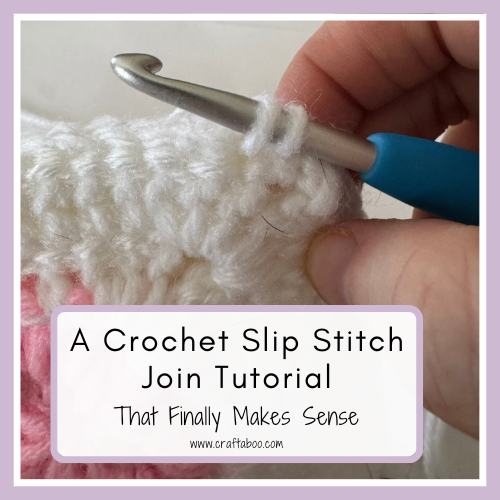
The slip stitch join is exactly what it sounds like, which is genuinely refreshing in a craft that names things like “the reverse single crochet” and expects you to just understand what that means. The long and short of it is this, you hold two finished pieces together and work slip stitches through the edge stitches of both pieces at the same time. That’s the whole concept, and it’s stupid easy.
What you get when you do it is a slightly raised seam that runs along the join line on the right side of your work. Some people see that seam and panic because it looks intentional and visible and they were expecting Harry Potter type magic to make it look invisible Crochet can do a lot, but that is slightly outside the realm of realistic.
This join method creates a strong intentional looking seam without adding extra bulk to your project the way other join methods sometimes do. And it is intentional in the way that grids look intentional. On a blanket made of squares, seam lines are part of the visual structure. The slip stitch join leans into that instead of fighting it, and the result looks like you planned it that way.
(You did. You’re planning it right now. Look at you go.)
It’s also fast. And consistent. And if you mess up a section you can pull it out and redo it without it turning into a whole thing, which if you have ADHD is maybe the most important fact, and I should have lead with that.
Projects That Are a Good Fit for This Join
- Granny square blankets and throws. The raised seam lines run along the natural grid of the squares and the whole thing ends up looking like you made a deliberate design choice, which frankly you did, even if the deliberate choice was “I watched a tutorial and followed instructions.”
- Tote bags and market bags. The join adds a little structure right where the seams are, and on a bag the visible seam reads as texture rather than construction evidence. Also bags take a beating and this join holds up.
- Pillow covers. Quick to work, easy to keep even, and because you can see exactly what you’re doing the entire time it’s a genuinely good project for practicing the method before you commit it to something bigger.
So Let’s Get Into It
Materials Needed:
Pile of finished pieces waiting to be joined
Yarn (duh) – preferably the same kind of yarn you were using on your project
Hook – Again, preferably the same hook you’ve been using during your project
Stitch Markers – optional but helpful
Oh, by the way, I encourage you to get my free beginner crochet guide (for when your stitches look wrong and you’re convinced you’re the problem – you’re not). It’s 35 pages of “Calm down you’re fine” and it’s completely free!
To Begin:
Grab two finished squares (or whatever two pieces you are joining) and hold them wrong sides together. Your slip stitch join is going to form on top of your work in a small intentional ridge. (If you don’t want this seam to show you can turn your squares right sides together so the seam appears on the back)


Then you will put your hook through any stitch (usually the corner) and connect your yarn by drawing up a loop and making one chain stitch.


From here you will insert your hook in the next stitch, making sure to go through both pieces at once, and make a slip stitch.
(If you’re having trouble seeing the stitches or keeping things lined up, stitch markers are a great way to visualize the next stitch. If you don’t have official stitch markers, bobby pins, safety pins, and scrap pieces of yarn work great as well!)


Continue along your project until you get to the end, fasten off and weave in your ends.

That is literally all there is to it. It seems overwhelming but it really is one of the easiest join methods around.
If you’re someone who learns by doing like me, I’ve got you covered. The whole video is below so you can pause and rewind as many times as you need.
Okay But There Are Other Join Methods and Denise Has Already Typed Four Paragraphs Into My DMs About It
Denise. I see your messages. I have a spreadsheet. I’m getting there. Sheesh…
Yes. There are other join methods. Several of them. More than is probably necessary if you ask me, but nobody asked me, and here we are. The slip stitch join is a great starting place but it is not the only tool in the box. And you should at least know what else exists so you’re making a choice and not just doing what some woman on the internet told you to do without questioning it. (Question things. Especially me. Like for real.)
Here’s a few of my favorite join methods:
- Single crochet join. Bulkier seam, very strong, adds more visual weight than the slip stitch. Great for projects that take actual wear like bags or placemats or anything a child is going to be aggressively dragging around. (Remember when I said I relied on one join method for two decades? Yeah this was it)
- Whip stitch join. Worked with a yarn needle instead of a hook, quick and clean, gives you a flat seam that sits right on the edge. Good for projects where you want something low-profile without committing to the full invisible join process.
- Invisible join. Exactly as advertised. Best for colorwork or anything where you really don’t want the seam to be part of the visual. Takes a little more patience than the others but the result is worth it.
- Join as you go (JAYG). You connect each square during construction instead of after. Efficient if you’re making something big, but it requires knowing your layout before you start making squares, which is a whole conversation with yourself you’ll need to have first.
- Mattress stitch join. Sewn join, yarn needle, nearly invisible result. The most time consuming of the group but it’s the one you want for garments or anything where seam texture anywhere on the finished piece would drive you absolutely insane.
Final Thoughts:
You learned a join method today. A real one. Use it on everything until it lives in your fingers and you stop having to think about it. (Only use it for good, never for evil.)
You came here with a pile of squares and a low-grade panic spiral and now you have an actual joined thing that is becoming an actual other thing. The dog is going to try to sleep on it before the ends are even woven in. This is just what dogs do. Accept it.
Now go make something awesome with your new superpowers.
PS. If you’re looking for other technique’s that patterns just assume you know how to do but you actually don’t, I’ve got you covered on my techniques and tutorials page Here you will find all the joining methods listed above, plus border ideas, finishing touches and other “Oh that’s how you do it!” tutorials.
And if you’re looking for more projects to actually use these granny squares in, head over to my granny square page and start browsing. (Take snacks, there’s lots there)


