You’ve learned to chain. You’ve practiced single crochet until your swatch finally looks less like a hairball and more like actual fabric. And now you’re sitting there, hook in hand, thinking “okay, cool, but what do I actually MAKE with this?”
A dishcloth. You make a dishcloth.
I know it’s not a squishy blanket or a tiny amigurumi frog with a little hat. But before you roll your eyes, this humble square of cotton is secretly the best first project on the planet. It’s small enough to finish fast, simple enough that you won’t need to check the pattern every five seconds, and useful enough that it’ll live next to your sink instead of in the drawer of shame. (Every crocheter has one. Mine is mostly hats that fit no human head.)
Even better, this whole pattern is written in plain, normal words. No pattern hieroglyphics, no abbreviations to decode, no wondering what “sc2tog” means and whether it’s a stitch or a license plate. Just sentences that tell you what to do next.
And here’s my favorite part. Nobody cares if your edges lean a little once the thing is covered in spaghetti sauce. TLC had some strong opinions about scrubs, but this one is absolutely welcome in my kitchen.
Grab some cotton yarn and your hook, and let’s make something you’ll use every single day.
Heads up: My posts may contain affiliate links! If you buy something through one of those links, you won’t pay a penny more, but I’ll get a small commission, which helps keep the lights on! Thanks!
Why a Dishcloth Is the Perfect First Project
Every new crocheter needs a project where mistakes don’t matter, and nothing says “low stakes” quite like something whose whole job is wiping up crumbs.
- It’s small. At about 7.5 inches square, you’re done before your hands get tired or your brain gets bored, which is a huge deal when you’re still learning. (Or have ADHD like me)
- It only uses two stitches. You chain to start, then work single crochet row after row, so your hands get to repeat the same motion until it finally clicks.
- It’s written in plain words. Every step is spelled out the way you’d explain it to a friend sitting next to you on the couch, so you never have to stop and translate.
- It’s cotton. Cotton soaks up water, holds up in the washing machine, and shows off your stitches so you can actually see what you’re doing. (Unless you decided to go for “hard mode” right from the jump and used black yarn. Then I can’t help you)
- It’s useful. You end up with something real, and those tend to multiply. (One dishcloth turns into a stack of six faster than you’d think.)
Once you’ve made one, you’ve officially gone from “learning crochet” to “making stuff,” and that’s a pretty great feeling to get from a square of yarn.
Before we dig in, here are some helpful links, no hunting required:
● My Go-To Supplies – The hooks and supplies I reach for every single time
● Yarn – Because duh
● Stitch Library – In case your chain or single crochet needs a quick refresher before you start.
Beginner Dishcloth At-A-Glance
Skill Level: Beginner (you know how to chain and single crochet, and that’s honestly all you need)
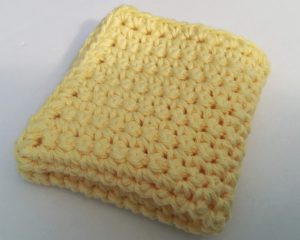
Finished Size: About 7.5 inches (19 cm) square, which is the perfect size for wiping counters, scrubbing pans, or hiding a stain on the table before company shows up.
Materials Needed:
Yarn: Medium worsted weight (#4) cotton yarn. I used Lily Sugar’n Cream, which is soft, cheap, and survives the washing machine like a champ.
Hook: A 6.0mm (J size) hook. Going a little bigger than usual keeps the cotton from getting stiff and gives the cloth a nicer squish.
Yarn Needle & Scissors – To cut your yarn and weave in those ends so your dishcloth doesn’t unravel in the sink.
(Babysitter, Netflix, Diet Coke, Snacks) – And a locking door on your bedroom so you can have some much deserved me time.
Let’s Make a Dishcloth
Stitches Used:
Chain Stitch – The very first stitch, if yours needs a tune-up before you start
Single Crochet – The only other stitch you’ll need for this whole thing
To Begin: Chain 25. Then, skipping the chain closest to your hook, single crochet into the second chain from your hook and into every chain after it, all the way across. When you get to the end, chain 1 and turn your work so you’re heading back the way you came. You should have 24 stitches. (That chain 1 doesn’t count as a stitch. It’s just there to get your hook up to the right height.)
Row 2: Single crochet into every stitch across. When you get to the end, chain 1 and turn. (24 stitches)
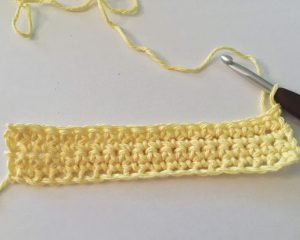
Still With Me? Good you’re doing great! Let’s keep going.
Keep Going: Repeat Row 2 until your dishcloth measures about 7.5 inches tall. This is the part where you turn on a show, get comfy, and let your hands do the same thing over and over until it starts to feel automatic.
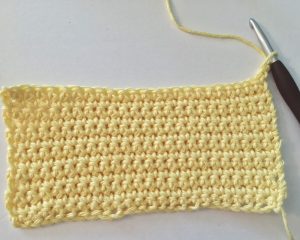
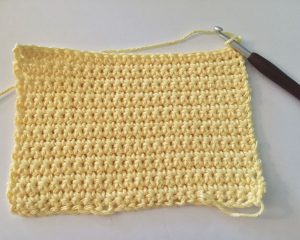
Your project is growing! Look at you go.
Finishing Up: Once your dishcloth is about 7.5 inches square (or whatever size makes you happy), it’s time to fasten off. Pull up a loop on your hook, cut your yarn so you leave a tail a few inches long, and pull that tail all the way through the loop to make a knot. Then grab your yarn needle and weave in your ends so nothing comes loose in the sink.
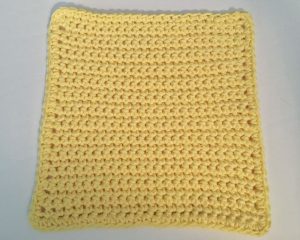
Want a Border? (Totally Optional): If you’d like a neater edge, skip the fastening off for now. Chain 1 instead, then work your way around the whole dishcloth, putting one single crochet into each stitch along the sides and three single crochets into each corner so it turns nice and square. When you’re back where you started, fasten off and weave in your ends. (If borders still feel a little mysterious, my single crochet border tutorial walks you through it.)
And voila! Your finished dishcloth is ready to scrub, wash, or show off to anyone who stands still long enough.
Some “oops” moments you might run into.
(You’re human and learning. These are normal.)
Q: My dishcloth is getting skinnier (or fatter) as I go. Why is it turning into a triangle?
A: You’re losing or adding stitches at the ends of your rows, which is the sneakiest beginner mistake out there. That first and last stitch on each row love to hide. Count your stitches at the end of every row for a while (you want 24), and clip a stitch marker into the first and last stitch so you can find them on the way back. If the shape is already way off, frog it back to where it started going sideways and pick it up from there.
Q: The count is right, but my dishcloth is still a little wavy and wonky. Did I ruin it?
A: Not even close. Cotton can come off the hook looking a bit rumpled, especially when your tension is still settling in. Toss it in the wash, then lay it flat to dry and gently pat it into a square shape while it’s damp. Most of the waviness relaxes right out, and the rest gets hidden the first time you use it on a greasy pan.
Q: It took me forever and it doesn’t look like yours. Should I just give up?
A: Absolutely not. I’ve been crocheting for twenty years, and my first dishcloth looked like it had been through a garbage disposal. The whole point of this project is to give your hands lots of practice, and that’s exactly what you just did. Make a second one, put them side by side, and you’ll see the difference with your own eyes.
Final Thoughts:
You made a thing. A real, useful thing that started as a ball of yarn and is now going to spend its life wiping up coffee rings and crumbs. That’s the moment crochet stops feeling like homework and starts feeling like magic, and you got there with nothing but chains, single crochets, and a little stubbornness.
If you want to keep that momentum going, my beginner friendly projects are full of patterns that stick to stitches you already know, so you can keep building without getting blindsided. And when you’re ready to add a new stitch to your toolbox, the crochet stitch library has every basic laid out in order, with photos and videos for each one.
And if somewhere around row 12 you started wondering whether you’re even cut out for this, I made a free guide for exactly that feeling. It’s called Don’t Panic, and it’s packed with the stuff I wish someone had told me when I was staring at my own crooked first projects. It costs nothing, so go grab it.
Happy Hooking!